Thao Trang Nguyen’s website
As a PhD Fellow in Economics of Innovation at UNU-MERIT, Maastricht University, my research is centered on the intersection of automation technologies, global value chains, industrial policy and firm-level performance. My work uses advanced econometric techniques to analyze firm-level data, with a current focus on Vietnam and France.
My research portfolio includes working papers that explore the effects of special economic zones on firm performance in Vietnam, the impact of automation adoption on reshoring and margins of exports, and the relationship between bank expansion and gender gaps in firm performance. My work has been presented at numerous international conferences and seminars, including events hosted by the Kiel Institute for the World Economy, UNCTAD, World Bank, and the European Trade Study Group. I was also honored with an honorable mention for the 2025 ADB-IEA Innovative Policy Research Award.
Research Interests: Innovation, Global Value Chains, International Economics, Industrial Policy
CV: Please see my updated CV
Contact: trangthao.nguyen177@gmail.com/ tt.nguyen@maastrichtuniversity.nl
Research
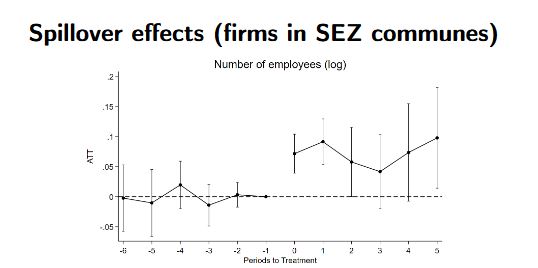
- “Special Economic Zones and Firm Performance: Evidence from Vietnam” with Karsten Mau and Tania Treibich - Paper, Slide
- This paper examines the impact of Special Economic Zones (SEZs) on firm performance in Vietnam, using firm-level dataset and employing cancelled SEZs as a control group to address endogeneity concerns. We find that SEZ entry leads to signifcant improvements in firm outcomes, with direct effects including a 18.3% increase in employment, a 55.3% rise in sales, and a 25.9% boost in labor productivity. Indirect spillover effects are also observed within communes hosting SEZs, particularly through improved labor productivity and sales of non-SEZ firms. Heterogeneity analyses reveal that foreign firms, large firms, science-based, and supplier-dominated firms beneft the most. Firms located in industrial SEZs seem to drive our results. We also provide insights into the mechanisms driving these effects, including enhanced credit access to explain why direct effects are stronger than indirect ones. Input-output linkage might explain why we have substantial effects for employment and sales, especially for spillover effects. However, the technology gap still remains a challenge for domestic firms as they experience labor productivity improvement when learning from SEZ firms with foreign direct investment originating from developing countries but show no signifcant gains when FDI originates from developed countries.
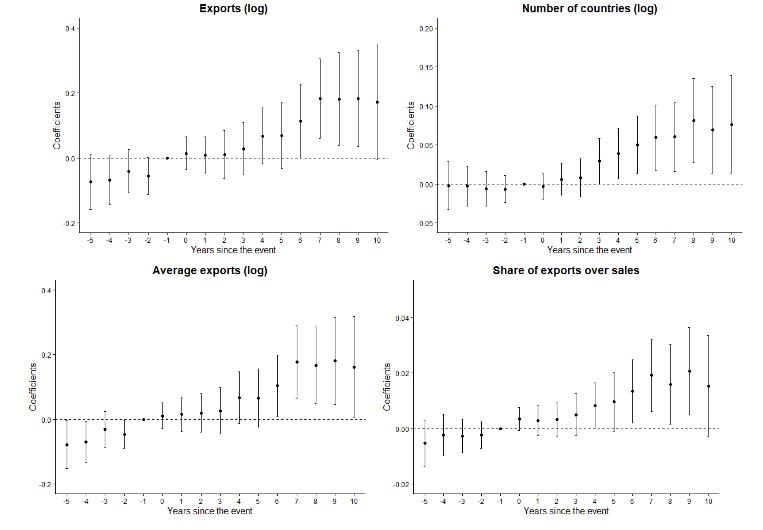
- “Automation Adoption and Export Performance: Evidence from French firms” with Giacomo Domini, Marco Grazzi, Daniele Moschella, and Tania Treibich - Paper, Slide
- We examine the effects of adopting automation technologies on the export performance of French manufacturing firms during the 2002–2019 period. Automation adoption is identified through imports of automation-related capital goods, and its effects are estimated by means of a staggered difference-in-differences method, complemented by an instrumental variable approach. Our results indicate that automation significantly improves export outcomes, such as export value, the export-to-sales ratio and particularly the number of destination countries. However, its effect on the number of exported products is limited. These results are primarily driven by single-product firms, which develop their product portfolios, often toward more complex products, and expand their presence in high-income countries. Multi-product firms, instead, tend to streamline their product offerings while targeting low-income markets. These findings underscore the distinct mechanisms of learning effects and resource reallocation that shape automation strategies and drive export success.
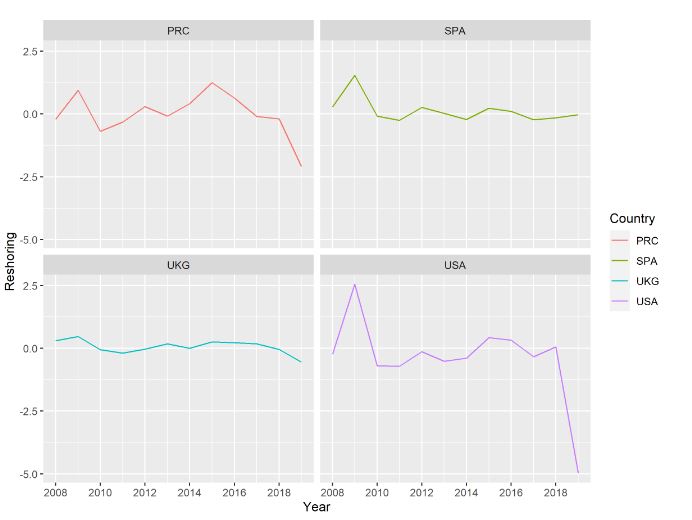
- “Automation Adoption and Reshoring: Evidence from Asian Input-Output Table” - Paper, Slide
- This paper examines the impact of automation adoption on reshoring for 61 countries during the period 2008–2019. Utilizing a novel flow-based reshoring measure based on the Asian Development Bank Multi-Regional Input-Output dataset and automation import records, we apply OLS and IV models. We find that the adoption of automation, specifically robotics, ICTs, and regulating instruments technologies, negatively affects reshoring and reinforces offshoring. The analysis also shows that economic uncertainty moderates this relationship; low uncertainty in a home country prompts reshoring as a risk-hedging strategy. Our findings challenge the notion that automation adoption universally drives reshoring, highlighting its role in sustaining global value chains and offering policy insights for balancing technological adoption with economic resilience.
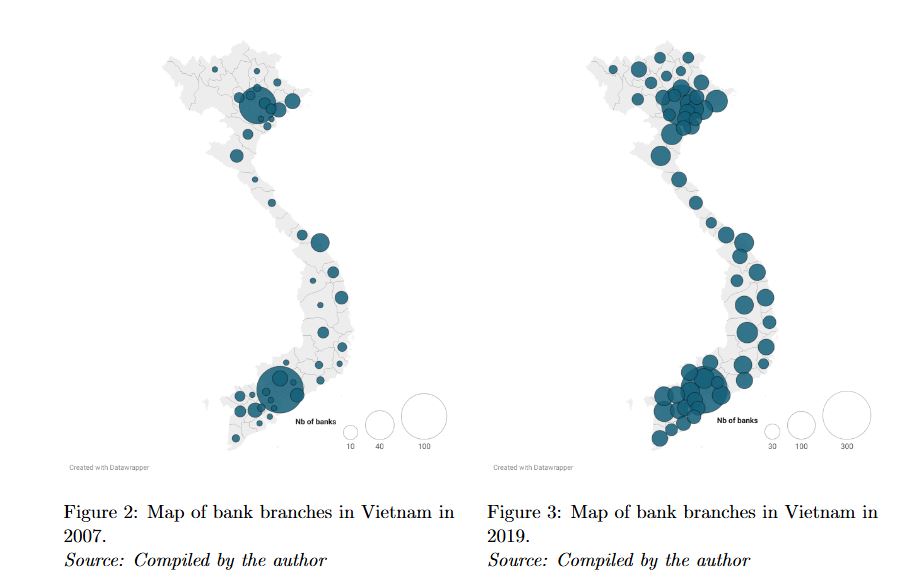
- “Bank Expansion, Firm Performance and Gender Gaps: Evidence from Vietnam” - Paper, Slide
- Expansion of bank branches has played a pivotal role in enhancing financial development and access to finance. Using firm-level and district-level data from Vietnam during 2007 - 2019, we document that (1) increased bank expansion has a positive impact on a firm’s revenue and number of employees, but not on labor productivity; and (2) this result is driven by men-led firms, while for women-led firms, we find no effects on firms’ sales, employment and labor productivity. This might be because men-led firms have a higher probability of getting loans compared to women-led firms with increased exposure to banks. Another interesting result is that if firms get loans, women-led firms have a higher probability of adopting modern technologies, such as cloud computing technology, advanced robots, and additive manufacturing technology (3D printing), with an increase in exposure to banks. Our results highlight the importance of bank expansion in increasing firms’ performance in developing countries, but suggest more policies in supporting women-led firms in accessing to banks, apart from increasing the number of bank branches.